
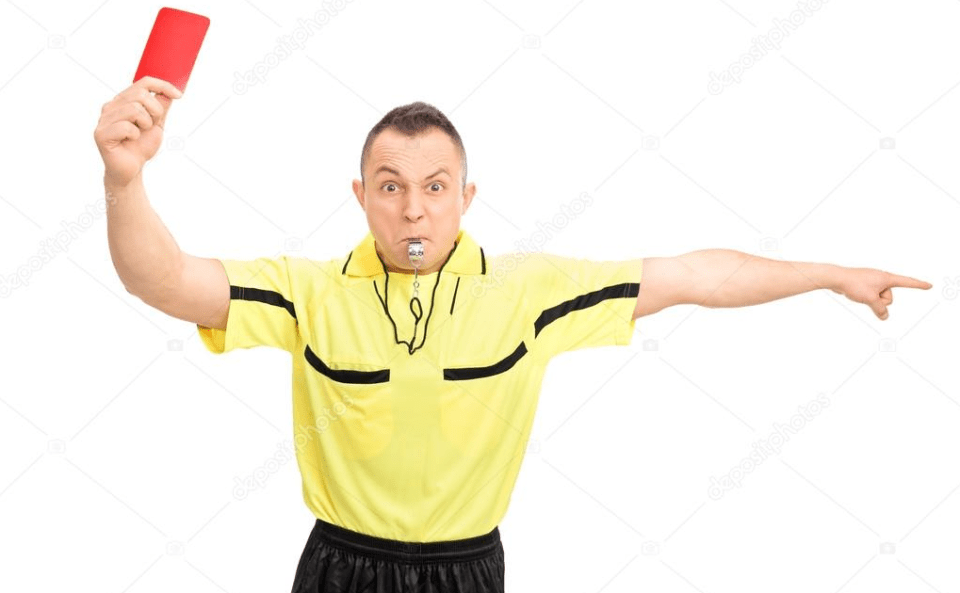
A stock photo of a referee showing a red card- Image Credit: Shutterstock
GRAPHIC CONTENT WARNING!!! Some Descriptions in this piece may be disturbing.
Nobody likes the referee when playing a game. It’s sad but it’s true. We all want our game to flow and to be able to use almost any methods to win. Referees get in the way of that. They are ‘no fun’ or the worst when things don’t go your way, but if an indiscretion occurs against your team, it’s suddenly an outrage. The job of the referee, or ‘ref’ for short, is to uphold the rules and spirit of the game in the match they are involved in. Rules are not fun; therefore, all ‘refs’ are not fun. Being the upholders of regulations set down by a governing body, ‘refs’ immediately have a target on their back for the ire of any fan of any team they officiate. It is worse than a thankless job and, in some cases, an actual death sentence. In all sports referees, umpires, judges, arbiters, commissaires, technical officials, and whatever else they’re called, receive some of the worst treatment in sport. But none have it quite as bad as those in soccer/football.
The treatment towards referees in soccer is deplorable, by professionals and fans alike. It’s no wonder that there is now a shortage of refs in the sport. I mean, why would you want to go into a profession where you get abused by 22+ people, directly to your face, on the pitch, and millions more in the stands and on social media during work hours? THEN receive more abuse outside of those work hours, extending as far as death threats sometimes? When put into those simple terms, it’s really not worth it as a profession. At the end of the day, we should be thankful that we have any referees at all. The fact that anyone would be willing to take abuse from their co-workers and the general public for 90 minutes plus is like retail work on steroids, and retail work is awful. Any job that involves humans is susceptible to human error and refereeing is no exception. It’s no secret that Mike Dean or Jon Moss got a few calls wrong in their time but that doesn’t mean their families should be at risk. Refs probably don’t have an agenda against your team, although it does seem like Anthony Taylor always has issues with Chelsea, but it is unacceptable to threaten someone’s loved ones over a ball sport that’s run by rich, detached billionaires.
This is not the case in many other sports. In Rugby Union, at the professional level at least, the referee is often highly respected on the field of play and will almost exclusively speak to the team captains and the individual who committed the offence, when dealing with players. In tennis the umpires may be challenged and certain players…*cough* Nick Kyrgios *cough*… may have an outburst every now and then but the umpire still sits above the court and their calls are, often, still respected. Even in Gaelic Football, referees are not crowded around, screamed at and pleaded with, like in soccer. When a foul is awarded and a player is judged to have caused an offence in Gaelic Football, there will be the typical, “ah f**k’s sake ref!”, and maybe a bit of handbags between the players, but it won’t often escalate much from there. There will always be the one individual that takes things too far, like the death threat Carthage Buckley received over his refereeing of the ‘Battle of Aughrim’ in 1986. This is only one of very few researchable instances in the extensive history of the GAA.
Soccer seems to reside in a different reality though. It seems that, in soccer, it’s fine for players on the pitch, coaches, managers, pundits and especially the fans, to show complete disrespect and hurl heinous abuse towards the officials charged with keeping order over the match in question. That those officials are simply sounding boards for the most disgusting collections of words that spectators can bark from the stands. As if 90 minutes of abuse wasn’t enough, social media has given the most vociferous spectators the power to never leave the officials alone. Insult after insult, verbal assault after verbal assault and, worst of all, threats of violence towards officials and their loved ones. Most of these are empty threats but not all of them, as illustrated in El Salvador in June of 2022.
José Arnoldo Amaya, 63, died in Zacamil Hospital from internal injuries, as reported by Marca. With 20 years of refereeing experience, Amaya took charge of an amateur game where he elected to show a second yellow card to a player. This would prove to be a fatal action, as the player, his teammates and supporters attacked the the 63-year-old and left him with the injuries that would ultimately lead to his premature death. The Salvadoran Soccer Federation condemned the actions of those involved in a statement, unfortunately, condemnation alone will not stop these instances.
To say José Arnoldo’s case was an isolated one would be a lie. Possibly, the most disturbing referee murder (horrific that there’s more than one) is the case of Otávio Jordão da Silva, who’s demise was medieval in its brutality. Full name: Otávio Jordão da Silva Cantanhede, according to The New York Times, the Brazilian was only 19 years old when he went to play a pickup game (an unofficial game, normally between friends) of soccer in Centro do Meio. Before setting out, he tucked a knife into his shorts or backpack, this would prove to be his undoing. Having injured his ankle in the first half, Cantanhede stood-in as referee for the second half and would deem an indiscretion on the part of Josemir Santos Abreu, 30, to be worthy of a yellow card. This would soon escalate to Abreu’s dismissal and an argument that led to Cantanhede stabbing Abreu twice, injuries which Abreu died from. (This is obviously not helping to make the point that referees need more protection, if anything, it sounds like players need protection from referees. Something must be wrong though if someone, who is only a stand-in referee, feels threatened enough to stab an arguing player twice, right?) The account continues, according to police, that four of Abreu’s friends reacted by beating and tying up Cantanhede, smashing a bottle on his face, running over him with a motorbike and stabbing his throat. To directly quote The New York Times, “graphic images taken by hospital workers showed that Cantanhede’s lower legs were cut off and left beside him like prostheses. His right arm and left wrist remained attached by strips of skin. He was decapitated and his head was placed on a wooden fence post across the road from the field.” For those interested in a much better account of the whole story, visit this link: https://www.nytimes.com/2013/11/03/sports/soccer/a-yellow-card-then-unfathomable-violence-in-brazil.html
I realise that the case of Otávio Jordão da Silva Cantanhede is part of a much larger issue of violence in Brazil, but I think it illustrates the point I’m trying to make. The fact is that referees are often seen as second-class citizens or as non-humans. They don’t have feelings, families, or personal lives. They exist only to referee soccer matches, like cyborgs who enter sleep mode once the match is over and are placed into pods to recharge for the next one. Violence towards referees is not just a problem in the far reaches of the favelas of Brazil or in El Salvador, it’s happening much closer to home. Only on the 4th of October 2022, The Guardian reported the arrest of a man, 24, who is suspected of assaulting referee Dave Bradshaw in a South Lancashire Counties League game. Bradshaw was reported to have sustained, “significant injuries”, but has since tweeted, “I’ll survive. Thanks for all the nice messages I’ve received. Up the refs.” The fact that he has to say, “Up the refs”, at all proves how ridiculous this has become.
Players and managers are often able to have personal (if sometimes tumultuous) relationships with referees and can be in regular contact with one another. The players and managers are not necessarily excused from helping the stigmatization of referees, and pundits have certainly contributed to it, with their vigorous scrutiny, but there is no one who is more of a threat to the safety of referees than the fans. Professional players, managers and pundits are under such intense scrutiny from fans, tabloid hacks, social media, and their own clubs that they’re, mostly, not able to veer from broad opinions or generic statements. It’s hard to support a group (referees) that most people dislike or even hate when you are told to be as vague as possible at all times. Fans, though, are private citizens who are not monitored by clubs or tabloids and can, therefore, say what they like. This is mostly harmless, with jibes about tactical setups, clubs being a mess or how they could do better, usual stuff to hear in a pub with football on. Out of these, there will be a small percentage of fans who send threatening messages. The problem lies with the even smaller percentage of those fans who will follow through on these threats. It is easy for fans to hide behind a username and send disgusting vitriol to a referee who is just doing their job and may have done it badly, but everyone has bad days at work. What little policing of fans there is on social media, more often than not, has laughable consequences. A ban for a few games or even life from football grounds if the antagonist can even be found. Referees are not perfect, it must be said. There is match fixing and corruption, but they run throughout all of sport. There is also glaring human error, but a referee doesn’t deserve a death threat because of that.
The effects of the treatment of referees are already being felt. In the video entitled Why Football Is Running Out Of Referees by Alfie Potts Harmer of the HITC Sevens YouTube channel, he states “In every country, association & league, the primary cause, according to referees themselves, is exactly the same and that is the abuses that referees are subjected too” (4:36-4:49). That video was posted on the 17th of August 2022, after the worst phase of the COVID-19 pandemic had put all new referee training on hold. ALMOST 3 YEARS EARLIER the Tifo Football channel posted a YouTube video entitled, Why are there So Few Football Referees in the UK? This is not a recent issue, it cannot be blamed on the pandemic, it is an endemic issue that is in the very core of association football and will destroy the sport if things don’t change soon.
Everyone takes referees for granted, it’s just a fact. They appear to be there to ruin the fun of the sport and disrupt the flow of a game, but do we ever think about how integral referees are to the sport. In simple terms, there would be no professional soccer without referees, no organised leagues, and no teams to support. An official game needs a referee, it cannot take place without one. So, why then, do we abuse them so? Why can’t we leave it at, “ah f**k’s sake ref”, and keep the referees in on the joke. They generally support teams too, referees aren’t allowed to referee a game that involves the team they support, that’s how serious they are about it. Referees even rant about other referees when it involves their team. The video of Mike Dean’s antics at Tranmere, while a bit OTT, proves that referees are often more passionate about their clubs than average football fans. They’re like us regular, match-going fans but even more fanatical.
So, the question remains, why is there such a torrent of torrid torment thrown towards them? (I know that’s a lot of t’s but I’m proud of my alliteration.) Why won’t anyone realise that we are driving important people on the pitch away from the game? Ignorance? Stupidity? Do we take referees for granted? It’s most likely all of the above and even more moronic reasons thrown on top of them. The problems are all over the sport, but they start with respect. Respect is a word that is thrown about the annals of soccer all too frequently with far too little meaning and even less action. When a sport is as global, as culturally significant, and as useful a political tool as soccer, it is going to bring out the beliefs, biases, loves, hates and thoughts of everyone involved in it, be that in a professional or recreational capacity. Racism, sexism, classism, tribalism, acceptance, inclusion, togetherness etc. are all bound to exist in a sport that is called the ‘global game’, it’s inevitable. The problem is, a lack of respect for referees doesn’t just exist in South America, the UK, the Balkans, etc. it starts at youth level everywhere.
In every country where youth soccer is played, referees are not shown respect at underage games. Parents, coaches, and onlookers all give the referee constant grief but shake their hand at the end like it makes everything okay. I can’t begin to count the number of times I’ve heard a referee being called a, “blind c*nt.” Bear in mind, NONE of the soccer I’ve ever played really meant anything of significance, it was all recreational. Soccer isn’t even the most popular sport in Ireland, Gaelic Games are still quite a bit ahead in that respect, but the culture is still geared against referees. So, what does that say about countries where soccer is the most popular sport? I’m not free from guilt here either, I’ve had arguments with and have been potentially disrespectful to referees from underage level all the way up to senior. I never really thought much of it until I picked up an injury and couldn’t play. Removing the rush of playing means you start to tune in to what people are actually saying, both on the pitch and the sideline. I’m not saying that I’m a good player, but I definitely have the same adrenaline rush that most players have, the rush that turns most of the shouts and calls from anyone outside of your teammates and coaches into white noise. Since I’ve started actively listening to what is said by everyone in attendance at a match, I’ve found a new appreciation for what referees go through every weekend. They don’t need to take that abuse for 2 hours of their Saturday or Sunday, they could go home and watch soccer on TV instead. Unfortunately, more and more referees are deciding to do just that, instead of officiating matches.
So, what do we do? Obviously, the current situation cannot be allowed to continue or else we will just run out of referees. No one can be expected to take that level of abuse in any walk of life and just put up with it. Things need to change, for real: no empty campaigns with catchy slogans like, “respect the ref”, or “respect our referees”, actual change needs to happen, and it needs to happen now. Otherwise, there will be no game, no one will even think about becoming a referee because it could be damaging to their mental & physical health. If people really care about the existence of recreational and professional soccer, then they need to wise up and start seeing things as they are, and things are bad. If a shortage of referees has been a noteworthy problem since 2019, then it can only be worse now, with the effects of the pandemic and increased media scrutiny. All of this means that there is not just one thing that needs to be done to counter the referee shortage problem but an entire culture change. From youth level, all the way up to the professional level, all attitudes towards referees need to become less deranged and more tolerant of human error because REFEREES ARE HUMAN.
The attitude towards ref’s is an institutionalised one; it has become normal but it’s wrong. Everyone needs to be a part of changing this specific part of soccer culture. I am not here to tell people how to raise their children or run their clubs/camps, but the onus is on the adults to be the example here. Those of us that tend to be involved with coaching children or supporting from the sidelines need to set the example of not constantly cursing at and threatening the ref. Disputing or disagreeing with a decision is completely normal, however, we all need to show that it’s possible to disagree or dispute in a respectful manner. This is difficult to do, I will admit; sport inherently brings emotions to the surface, including anger, so, everyone keeping a level head all the time is impossible; someone will lose their temper in the course of a soccer season. However, there is no need for a chorus of profanities and hostile atmosphere every single weekend but that is, sadly, what is happening. If we start there, and stop treating ref’s so poorly at youth level, then we’ll start to see results. If the younger generations are shown that it’s possible to play an emotionally charged sport and show a degree of respect to the officials in charge of that sport, then it can only benefit the foundations of that sport. People are more likely to become referees if they feel they are not going to be verbally and emotionally (and potentially physically) assaulted every single time they officiate a match, it’s just common sense.
Everyone involved in the sport needs to make this effort, though, all the way up to the top level. A culture change can only happen if the majority of people involved in something are willing to make that change. If a majority want to change the attitudes towards referees, then those clinging to old habits and attitudes will eventually disappear. It needs to be active change though, if the way the world is now has taught me anything, it’s that being too passive about things never changes anything. For example, on a team someone, you would hope the club, is going to have to do the thing that feels awkward and tell those who give the ref non-stop abuse to stop. It’s sickeningly awkward, I know, but it will have to be done. This doesn’t mean that every single thing said against the ref needs to be highlighted but the truly disrespectful stuff does. The occasional, “ah come on”, or “f**k sake ref”, isn’t the end of the world, we can’t just cease complaining or being annoyed but a line needs to be drawn somewhere. With that, we can only hope that, with campaigning and increasing scrutiny, something will change at the top level.
The attack on Anthony Taylor and his family by a deranged group of Roma fans only highlights the issues that are being faced. Roma lost on penalties to Sevilla in the Europa League final, UEFA’s second tier of cup competition. Fans criticised Taylor’s performance in the game. Criticism is fine, but these fans took the final result as permission to harass and attack a man and his family at Budapest Airport. That is wrong and everyone with a shred of humanity knows it. Hopefully, we don’t keep going backwards in this regard.
By Owen Coyne
 Taken to the Corner