

Image Credit – https://mrfixitstips.co.uk/
Yes, this title works as a joke and as an assessment. When Irish people say ‘the state of…’ something, it is almost always a way of addressing something negatively, mostly in Dublin. For example, if someone was having a bad hair day, someone else could say, ” the state of your hair”, which translates as, “your hair looks bad.” You could also say something is, “in a state”, and it means basically the same thing, e.g. “your hair is in a state.” In America, who make up around 60% of the readership on everything I’ve ever written on this site, the State of the Union Address is an annual address given by the President to Congress in one of the first three months of the year. Bearing both of these meanings in mind, this is my ‘address’ of the ‘State of the Irish Soccer Team.’ Bad jokes are less fun when you feel you have to explain them. Irish people can skip to the next paragraph. For anyone who doesn’t know, Ireland is one island but is divided into two countries, the Republic of Ireland (South) and Northern Ireland (obviously the North). The Republic is its own country and an independent state with its own parliament while the North is part of the UK. The island of Ireland, including the North, is divided into counties. These counties act as their own smaller governing bodies for their regions, in an official capacity, but have also created fierce rivalries and a sense of tribalism (not in the literal cave people sense) throughout the entire country, especially in regards to the GAA. There are 32 counties on the island of Ireland overall, with 6 of these making up Northern Ireland. Here’s the thing. We have our own sports but we love soccer too and we’re not great at it. The brief lesson for the Americans and the Chinese, the latter of which are surprisingly the third largest readership I have, is now over.
Notice that I didn’t title this as the ‘State of the Republic of Ireland Soccer Teams’ or the ‘State of the Northern Ireland Soccer Teams.’ There is a reason for that. With several sports already being unified in Ireland, most notably the GAA All-Ireland Championships and the Irish Rugby team, and Irish Reunification looking more likely than it ever has in my lifetime; it’s time to really look at the idea of the Republic of Ireland and Northern Ireland’s soccer associations merging operations or at least agreeing to have more of a cross border relationship. There are a few good reasons to as well. For a start, both of the men’s national teams are going nowhere fast. The Republic’s national team (ROI) sits 60th in the FIFA rankings, which is generous if you ask me. The North’s national team (NI) are 73rd. Having previously achieved the highest ranks of 6th and 20th best in the world, respectively, the decline of both has been nothing short of catastrophic. Neither team has qualified for a World Cup since ROI in 2002, which went okay on the pitch but was a shitshow off of it. The last time NI qualified was in 1986. Interestingly, both teams qualified for the 2016 UEFA European Football Championship, known as Euro 2016 for short, which is like a World Cup but just for European nations. Both progressed from the group stage, only to be knocked out in the Round of 16, the first knockout round of the tournament. However, 2016 was a false dawn for both nations as things have only gone downhill since then. ROI has been suffering through the dismal displays of Stephen Kenny’s reign over the side. NI haven’t recovered from manager Michael O’Neill leaving to join English Championship side Stoke City in 2020, even though he’s back in charge of the national team now. He is not to be confused with Martin O’Neill who was in charge of the Republic’s national team for 5 years but did also play for Northern Ireland over 60 times in the 1970’s and 80’s. So, I’ve decided to write here how I would merge the two organisations.
Men’s National Teams
The number of high-quality players for both senior men’s sides has also become an issue. ROI had their best crop of talent during the Jack Charlton era of 1986-1996. The team could boast several top-level players in leagues around Europe. As recently as the early 2010’s, ROI could name a starting XI made up almost entirely of players from the Premier League, probably the highest quality league in the world, as well as the customary few players from the Scottish Premiership, Scotland’s top division. ROI have, at various stages, had individuals like Robbie Keane, Damien Duff, Shay Given, Packie Bonner, Paul McGrath, Roy Keane (no relation), Tony Cascarino and many more represent the national team. NI have the distinction of having the only player from either nation to win the Ballon d’Or, the award given to, at the time, the best player in Europe and is now given to the best player in the world. That player was George Best in 1968, who also won the European Cup (now the Champions League) with Manchester United in the same year. The best (pun intended) player to represent either national team, and by some distance, Best himself was a proponent for a united Ireland national team. At various stages, NI have had talented individuals represent their national team. Top scorer David Healy had a long career in England and Scotland. 1958 World Cup captain Danny Blanchflower is considered by many to be Tottenham’s greatest player of all-time. Pat Jennings made 119 appearances for NI from 1964-1986 and is considered one of the best goalkeepers to ever grace the game. Norman Whiteside still holds the record for the youngest player to take part in a FIFA World Cup, was a regular for Man United throughout the 1980’s and remains United’s youngest ever goalscorer, a record he set when he scored against Stoke City at 17 years and 8 days old. More recently, former long-term captain Steven Davis, who recently retired, is the most capped British footballer of all-time for any one of the four British nations (caps are appearances for the national team). Current NI captain and possibly the best player from either nation at the moment, the criminally underrated Jonny Evans, returned to Man United in the summer of 2023 at 35 years old, now 36. Originally on a short-term contract with a view to becoming a player-coach, he has become a regular for the club as the 23/24 season has gone on. With all of that quality being produced by both nations, the thoughts of what a unified Ireland team could have done is the stuff of fantasy.
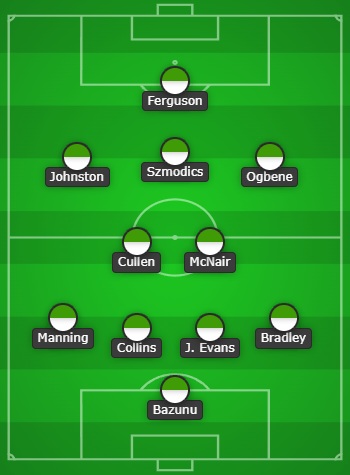
Credit – chosen11.com
For the men’s team, the above starting 11 is the best I can come up with out of the current crop of players from both national teams, without taking injuries and suspensions into account. This is very interchangeable though, as is the nature of national team selection. Admittedly, the lineup is a bit Republic heavy, but there are two main reasons for that. 1. There are more top division players in the ROI squad. 2. I watch more of the ROI team’s matches, although I do often avoid torturing myself with that spectacle. By picking players from both sides, a few issues that the teams have had while separated can be addressed. For instance, while a decent goalkeeper, Bailey Peacock-Farrell (NI) is inconsistent and can drop the odd clanger. While young and also inconsistent at times, Gavin Bazunu (ROI) is more consistent and has had a good season for Southampton in the EFL Championship, the second highest league in the English football pyramid. NI have a more solid defence, partly because they play a 5 at the back system, but also, they have more defensively resolute individuals. Jonny Evans, the most experienced and, arguably, best player on the team, would have 22-year-old Nathan Collins (ROI) to partner him and act as his protégé. This defensive solidity would not be lost if Paddy McNair, NI’s central defender, is simply moved to midfield, a position he has always played just as capably as he plays in defence. McNair would also be able to drop back into defence to create a back three system. The midfield of Cullen and McNair would mainly be there for solidity and ball recycling. This would allow the creative full-backs Ryan Manning (ROI) and Conor Bradley (NI) to push forward and use their crossing abilities to create chances for the attackers. Manning is also able to migrate into central midfield, as he has played much of his career there, to provide creativity next to Cullen when McNair drops back to support the defence. This would also allow Conor Bradley more freedom down the right flank to flex his attacking muscles. Attack is a problem for both teams but particularly for NI, who are fairly toothless in that department. ROI at least have the hope of Evan Ferguson as the future of the Irish attack. It’s a lot of pressure to put on a guy born in 2004, but he’s the best we’ve got. Adam Idah (ROI) has seen a huge improvement in form since his loan to Celtic and is putting pressure on Ferguson’s starting spot for the actual national team. Sammie Szmodics is this season’s Championship revelation. He’s the top scorer in the league, at the time of writing, and got his first caps for ROI in 2024, having also been eligible to represent England and Hungary. A creative attacking midfielder with brilliant passing and a serious eye for goal, standing at 5 foot 6 inches, he would complement the larger presence of Ferguson or Idah. Szmodics would also be able to rotate with Ferguson mid-game to confuse oppositions thanks to his versatility. Wingers are a bit of a struggle for both teams, but ROI do have the better ones for sure. Chiedozie Ogbene plays mainly as a traditional right footed right winger, an odd sight in the modern game, and can operate as a striker. This means he could dovetail nicely with Ferguson and Szmodics, offering wide support and rotating with them to make space while also drawing markers out of position. This leaves Mikey Johnston with a bit of freedom, which is exactly what he needs. Born in Scotland and qualifying for the Republic through a grandfather who was born in Derry, Johnston is an extremely un-Scottish and un-Irish player. Creative, dynamic and full of flair, Johnston plays similarly to the raft of Portuguese wingers that followed Cristiano Ronaldo’s emergence, which makes some sense as he was previously on loan in Portugal. Having struggled with consistency and form for his parent club Celtic, Johnston’s loan to West Brom seems to have been a jumpstart for his career. In the Championship he’s been scoring goals like never before and even won the EFL Championship Player of the Month award for March 2024. With a bit of freedom in this Ireland team, he could be an absolute menace to opposition sides. A substitutes bench of 15 players would, for me, consist of Caoimhín Kelleher, Dara O’Shea, Jake O’Brien, Festy Ebosele, Séamus Coleman, Will Smallbone, Jason Knight, Adam Idah (All ROI), Bailey Peacock-Farrell, Daniel Ballard, Jamal Lewis, Shane Ferguson, George Saville, Shea Charles and Josh Magennis (All NI). Players like Andrew Omobamidele, Shane Duffy, Robbie Brady, Liam Scales, Callum O’Dowda, Jayson Molumby, Mark Travers, Jamie McGrath, Finn Azaz, Troy Parrott, Aaron Connolly and Michael Obafemi, all from ROI, would always be competing for selection as well as Northern Irish players like Conor Hazard, Ciaron Brown, Trai Hume, Jordan Thompson, Ali McCann, Conor McMeniman, Corry Evans (brother of Jonny), Isaac Price, Brodie Spencer, Paul Smyth, Ross McCausland, Jamie Reid, Shayne Lavery and Gavin Whyte. Cross border players are not even a new thing. Players like Shane Duffy, James McClean, Darron Gibson, Marc Wilson and others have made youth appearances for Northern Ireland, having been born there, and then switched to the Republic at senior level. Johnny Gorman seems to be the only player I can find that swapped from the Republic at youth level to Northern Ireland at senior level. Alex Bruce, son of Man United legend Steve Bruce, is the only player to have made senior international appearances for both teams since the 1953 mandate that stopped players playing for both sides at will. Based on the players and the structures of the teams, the two joining forces could turn them from a pair of poor sides into one coherent and possibly competitive team. And in charge as manager of this team we’re getting a local because we’re going to try and do everything locally here. There are proven benefits to this, it’s not some strangely veiled nationalist idealism. For this team I’ve made, I want the Ipswich Town revelation that is Fermanagh’s Kieran McKenna, who, since 2021, has worked wonders with the side sponsored and supported by none other than Ed Sheeran. In reality, ROI is the exception rather than the rule in this case. Two of our best and most recognised national managers, Jack Charlton and Giovanni Trapattoni, were foreign. Charlton became an honorary Irish citizen, but he didn’t take charge as one, and Trapattoni is simply one of the best soccer managers ever. NI have had much more success with Northern Irish managers being in charge of their national team than foreign ones, with only two of their managers since 1980 being foreign and both being terrible.
Men’s National Leagues & Clubs
So, the men’s national teams would very likely benefit from merging, if even just to become one competent side, and that could be done at almost any time as long as the two teams don’t have meaningful games to play. But, what about the other things that could come with that merger, the difficult stuff. What if the two league systems joined together? What if the NIFL Premiership of Northern Ireland and the League of Ireland (LOI) Premier Division of the Republic of Ireland became one All-Ireland league? Currently, the NIFL Premiership consists of 12 teams and operates as a traditional ‘winter league’ following the same schedule as the English and many other leagues. The League of Ireland Premier Division consists of 10 teams, one of which, Derry City, is from Northern Ireland, and operates as a ‘summer league’ with a schedule that starts in February and ends in November. Is it as simple as just merging the two leagues into one 22 team league and deciding on whether it’s a summer or winter league? Maybe. However, given the fact that the English, Italian and Spanish top divisions are comprised of 20 teams, the German Bundesliga and Dutch Eredivisie have 18 teams and the French Ligue 1 reduced itself to 18 teams from the 2023/24 season onwards, it seems that more than 20 teams in a league isn’t the way things are going. There would likely be several arguments over how this league would come to be. Many administrative, logistical, structural, and competition issues would be raised, likely causing months, if not years of stoppages to any actual league creation. But let me conceptualise for a moment. Let’s assume that all of the paperwork and decisions go through easily. What kind of league could be systematised from the merging of these two well-established divisions, and would it be beneficial to anyone? Well, to start with, the marketing campaign for a merging and restructuring of the two leagues into one could be immense. Attendances for both leagues have been rising year-on-year for the last decade; the League of Ireland record champions, Shamrock Rovers, have added a new North stand to their home, Tallaght Stadium, increasing the capacity of it to 10,000 seats. Linfield, the record champions of the NIFL Premiership, play their home games at Windsor Park in Belfast, which they rent to the Northern Ireland national team, and has a maximum capacity of more than 18,000. Linfield don’t fill the ground, but the capacity is there. Couple these rising figures with the fact that the NIFL Premiership has enough viewership to be on the BBC iPlayer and the surprising popularity of the League of Ireland’s streaming app, LOI TV, and you realise that there is a burgeoning and feverishly passionate fanbase already there. With the right advertising and scheduling of matches that suits the fans, there is a plug and play audience waiting to be tapped into.
At the moment, in reality, the LOI Premier Division has 10 teams competing in it. These teams all play each other 4 times throughout the course of the season to end up playing a total of 36 games. The top 3-4 teams qualify for European competitions. The 10th placed team are guaranteed to be relegated to the League of Ireland First Division each season and the 9th placed team go into a relegation playoff. The relegation playoff sees the 2nd, 3rd, 4th and 5th placed teams in the First Division play knockout games against one another. The winner then plays the 9th placed team in the Premier Division in a playoff final to decide who will be in the Premier Division in the next season.
| Position | Team | Games Played | Points | Status |
| 1 | Shamrock Rovers | 36 | 72 | Champions & qualify for Champions League |
| 2 | Derry City | 36 | 65 | Runners-up & qualify for Conference League |
| 3 | St. Pat’s | 36 | 62 | Qualify for Conference League |
| 4 | Shelbourne | 36 | 60 | Qualify for Conference League |
| 5 | Dundalk | 36 | 58 | |
| 6 | Bohemians | 36 | 58 | |
| 7 | Drogheda United | 36 | 41 | |
| 8 | Sligo Rovers | 36 | 37 | |
| 9 | Cork City | 36 | 31 | Relegation playoff |
| 10 | UCD | 36 | 11 | Relegated |
| Quarter-finals | Semi-final | Playoff final |
| (2nd) Waterford – 4 | ||
| vs | ||
| (5th) Athlone Town – 2 | Waterford – 2 | Waterford – 2 |
| vs | vs | |
| (3rd) Cobh Ramblers – 2 | Cobh Ramblers – 1 | (9th in Premier) Cork City – 1 |
| vs | ||
| (4th) Wexford – 1 |
The NIFL Premiership is a lot more confusing. 12 teams play each other 3 times to have played 33 games each in the regular season. Then the playoffs start, and things become… ludicrously complicated. The top 6 (A) and bottom 6 teams (B) are separated into two playoff groups to decide the overall champions from the top 6 and the relegated teams from the bottom 6. This is an extra 5 games at the end of a 33-game season to decide how the season concludes. The team that ends up first in group A after those extra games are crowned champions and qualify for the Champions League. Second place qualifies for the Conference League. The team that finishes bottom of group B is relegated to the NIFL Championship. 11th place qualify for the relegation playoff. Unlike the LOI relegation playoff, the NIFL relegation playoff has the 11th placed team in the Premiership play two games against the team that finishes 2nd in the NIFL Championship to decide who plays in the top division. It doesn’t end there though. There is also the Conference League playoff that sees the teams placed 3rd-6th in the NIFL Premiership play knockout games against each other. These decide who is the third team in the league to qualify for the Conference League. And breath. I’m not making tables for all of these games because there would need to be an explanation and side notes with every single one, so F that.
Moving on, how would a new league actually be structured then? Well, I’m not the Chairman of either the Republic’s Football Association of Ireland (FAI) or the North’s Irish Football Association (IFA), and I’m certainly not a sports administrator, although sometimes it does look like a handy number to do any one of those jobs, especially if your name is John Delaney. Anyway, I have no experience in this field and no right to make any decisions in this regard, but I can still make stuff up. So, in a world where I’m the Chief Mergers & Acquisitions Officer for the deal between the FAI & IFA to merge the men’s leagues, what would I do? To start with, I’d want this to happen sooner rather than later, so, I’d want the merger to take effect in 2025. That would never happen in reality, but we’re not talking about reality. In total, there are 22 teams when both leagues are added together. I think a 20-team league would be ideal, which I wouldn’t be too inimical towards becoming an 18-team league in the future. While this looks like it means only losing two teams, it actually means losing four teams and adding two (which sounds like the same thing, but I’ll explain this later) due to the promotion and relegation systems that European soccer leagues operate on. After that initial headache, I reckon it could start to function like most of Europe’s other top divisions, except for Belgium’s because theirs is weird. Each team would play every other team twice, to finish a season having played 38 games, like the NIFL Premiership and the English Premier League now. (This would be a 34-game season for an 18-team league.) Teams get 3 points for a win, 1 for a draw and 0 for a loss and all the other normal rules would apply. The top four can qualify for European competitions, and I reckon we could push to get Champions League qualification spots for the champions and the runner-up, since both leagues have Champions League spots for their champions in reality now. This would mean that the 3rd placed team could qualify for the Europa League, the secondary European competition, and 4th place would qualify for the Conference League, the tertiary European competition. I believe the teams that finish 18th, 19th, and 20th should get relegated and that relegation playoffs should be scrapped all together. As far as I’m concerned, relegation playoffs only benefit the top division teams and are there to only benefit top division clubs that are managed badly, allowing them to take on weaker opposition who don’t have the financial muscle to compete. I do enjoy promotion playoffs though, so a playoff can be made a competition exclusive to second division teams trying to get promoted. That’s something that also needs to be addressed, the second division and those further down the pyramid.
The second divisions that currently exist in ROI and NI operate exactly the same as their respective top divisions. They encompass the best teams, or teams that have enough airgead (money), to have qualified from the regional divisions and are then all put into the national system. This means that, at the moment, in both countries, the top two divisions are the national divisions and everything under them are regional. In ROI, the League of Ireland First Division, yes, it’s confusing, is actually the second level on our pyramid, under the Premier Division. In NI, the NIFL Championship is their second division, under the Premiership. These second divisions would also merge, and I reckon we could get away with starting a third national division, which NI already has and consists of 14 teams, but more on that later. Staying on the second division, the LOI First Division has 10 teams and the NIFL Championship has 12, so these could be merged to make a 22-team league, or my 24-team league, which is where the losing four and adding two teams I mentioned earlier comes into play. In the season prior to the restructuring, we would forego the playoffs and just relegate the four teams from both top divisions who are in the relegation places. However, only the champions of the two second divisions would be promoted, with the second placed teams remaining in the, now unified, second division. This would turn the newly formed national second division into a 24-team league, essentially slapping the two divisions together, making our new system reminiscent of the English league system, which is a very successful template to build off of. Yes, it is annoying to emulate the English, but, as a league system it’s been hugely successful, even if most English clubs are habitually on the verge of collapse. It also allows for a smoother transition to the new league system, with less teams needing to be relegated further down the table and provides a first season of relative stability and fairness, as only the teams that deserve to be relegated from the top two divisions would be and then added to the second division. This would mean less movement and potential confusion further down the pyramid, making all further structuring much easier. From then on, 1st and 2nd place would be automatically promoted from the second division to the first, with the teams between 3rd and 6th going into a series of playoff games to decide which would be the third team to get promoted. This is, honestly, mainly for fun. While it is right to think that the 3rd placed team should be promoted too, a playoff competition is just more entertaining. If anyone has ever watched the EFL Championship promotion playoffs, then they know that those games are some of the most emotional, stressful and joyous spectacles of soccer that you will ever see and, as a Southampton fan, I am sure to experience some of them. I would also say that the bottom three teams should, again, be relegated with no playoffs because relegation playoffs are bullshit. The regular league season would see teams play 46 games and playoffs would be an additional 3 games.
| Game 1 | Game 2 | Playoff Final |
| 3rd – Home | 6th – Home | |
| vs | vs | |
| 6th – Away | 3rd – Away | Winner 1 |
| vs | ||
| 4th – Home | 5th – Home | Winner 2 |
| vs | vs | |
| 5th – Away | 4th – Away |
The format for the third division that I’m creating here would be the exact same as the second division above. 24 teams with 2 automatic promotions for 1st and 2nd, promotion playoffs for 3rd-6th to decide the third team promoted and relegation for the bottom 3 teams. I think this is a fine system. Since NI already have a national third division consisting of 14 teams, I think it’s only fair that all 14 of those teams are incorporated into the new third division of my imaginary All-Ireland soccer league automatically. This would mean that 10 teams need to be taken from the LOI system to make up the rest of the 24. This may be a little more difficult than expected as ROI does not have a national third tier only provincial ones. Also, both Connacht & Ulster have now defunct senior leagues that functioned as third divisions for the LOI along with the active Munster & Leinster senior leagues. On top of this, teams don’t currently get promoted to the LOI First Division from the Munster or Leinster leagues, they have to apply to the FAI to be accepted into the LOI system. For this third division, I’d scrap that and take the 10 teams that I think would be competitive and represent their provinces best at this level. So, because they both still have functioning leagues at the third level, I think it’s only fair that Leinster & Munster get 4 teams each into my new third division. Unfortunately, this means that Connacht & Ulster only get one each as a sort of punishment, I guess, for having none. From Leinster, or basically Dublin, unfortunately, I’m taking Crumlin United, Malahide United, Bluebell United and St Mochta’s FC. From Munster, or Cork really, we have Rockmount, UCC, Midleton, and Avondale United. The Ulster representative is Cockhill Celtic (trying VERY hard not to laugh at that) and the Connacht one is Mervue United. That completes our 24 teams for the third division. I don’t think there needs to be a national fourth division, I’d say everything below this third division can remain regional. However, I believe that getting into the national system shouldn’t be through an application process. I think that the teams finishing as regional champions should have playoffs against one another while also meeting certain structural and infrastructural criteria to qualify for the third division. I know this could act as a barrier to entry and means that very small teams punching above their weight may never get to the top, and that is the opposite of what the European system is meant to do, at least in theory. But, if a club has a pitch/stadium that is too dangerous for more away fans to attend, then it cannot qualify for the national divisions, where droves of fans will be descending on the grounds to experience games. It’s simply too much of a risk.
Having done all that, I feel that I’ve restructured and expanded the national league system, as well as simplified it. As Chief Mergers & Acquisitions Officer for the FAI & IFA merger, I’m feeling pretty pleased with myself. In my imaginary merger, we’ve now gone from the Republic having 2 national divisions and the North having 3, each one being between 10-14 teams, to having 3 All-Ireland divisions, with the second and third divisions having 24 teams and the top division having 20 teams, to give that feeling of exclusivity to the top. Each team in these divisions plays the other teams twice over the course of the season, rather than the 4 times that LOI teams each other, or the total insanity of the NIFL leagues. This does resemble the EFL system an awful lot, but it is a much less complicated system than what either Irish nation currently has. An uncomplicated system with a regular schedule to follow is also brilliant from a marketing perspective. It means that you don’t need 4 explanations for different parts of the season, and you don’t have to keep googling what the next game means for your club. You can enjoy each match for what it is, entertainment. The confusion of the Northern Irish playoffs are just a scheduling, planning and following nightmare because there’s four different playoffs for totally different prizes. In the Republic, a 10-team league is, in my opinion, a little bit underwhelming. I will say, I have probably been spoiled by watching the likes of the Bundesliga, Premier League, Serie A, La Liga and so on. So, the ‘regular’ systems I’m used to may have coloured my views on how leagues would work best, but to me, they are the best leagues to watch. But having a larger variety of teams adds flavour; 4 games against the same team in an LOI Premier Division season gets stale and, I believe, hinders competitiveness. With more teams comes more tactical variety, meaning players and coaches in the league have to improve and be ready for a wider variety of opponents.
Back to how my imaginary leagues operate, I would set a summer schedule for the All-Ireland soccer league. This would mimic the LOI schedule but strays from the NIFL one. That’s not random or some North vs South rivalry stuff. I think a summer league makes sense so that the new leagues aren’t competing with the top European leagues for viewership. Currently the top leagues of the top 10 countries by UEFA coefficient, the exclusively European soccer rank index, all operate as traditional winter leagues, as do most of the rest beneath them. So, why not just avoid competing with them? Most soccer fans can never get enough of the sport and, once the leagues of other countries conclude, they could casually gravitate to these leagues I’ve made up here and boost the hypothetical viewership. Another massive factor for a summer league in Ireland is the weather. 99% of the time, the weather in Ireland is crap, and not many casual fans would be arsed dragging themselves to a soccer match in Inchicore in 2° C with wind and rain in the middle of January. But 15° C in probably overcast weather with little bursts of sunshine here and there is much more bearable and could even be a day out. This would mean that the main competition for viewership would be from the GAA, which doesn’t even need to be a competition. At the moment, most GAA games in both football and hurling begin in the afternoon, mostly between the hours of 1-4pm. Most LOI Premier Division games kick-off between the hours of 5-7:30pm in the evening, on mostly Fridays or Mondays. Just keep this the case and add Saturday and Sunday evening games. This avoids most clashes with the GAA and creates entire weekends of sport for the true sporting fanatics out there. This means more local sport to watch for everyone and I see nothing wrong with that. My season would run by the current LOI schedule, starting in mid-February and ending in early November.
Domestic cup competitions are a part of every soccer season too. These are separate tournaments where every game is a knockout game. All nations have nationwide cup competitions that every eligible team in the country can enter. The FA Cup in England or the Coupe de France are great examples of these kinds of competitions. Some nations, like England, have two nationwide cup competitions and a domestic super cup competition, where the reigning league champions play a single game against the reigning cup winners. For my imaginary All-Ireland league, I would only have one domestic cup and one super cup competition. I personally think that soccer players have too many games to play already, so I don’t want to contribute to that problem by having two knockout cup competitions. The cup competitions that I would have would function as a normal domestic cup competition and super cup competition would, from the explanations I have already given. The domestic cup would be open to entry for regional teams too, not just to the national division teams.
With all of that structuring and scheduling done, what do we call these new leagues and competitions? I fundamentally disagree with naming systems for leagues that have the wrong number on the wrong levels. Currently the second level of the League of Ireland is called the ‘League of Ireland First Division.’ That’s stupid. It doesn’t make sense. England is ridiculous though. Both in general and in the case of how they’ve named their football leagues. The top division in ‘Engerland’ is called the Premier League. That’s fine. The second division is called the EFL Championship. So far, we’re okay. However, the third division is called the EFL League One… WHO THE HELL THOUGHT THAT WAS A GOOD IDEA?? Worse still, the fourth division in England is called the EFL League Two. WHY? Why did anyone think that was okay? That means that 1=3 and 2=4 because the other two divisions use words as descriptors. It’s ridiculous and I hate it, so that’s not how I’m naming my leagues. First Division, Second Division and Third Division and similar names are a bit boring for me, but they do make the most sense. Sequential numbers would do the job but are, again, a bit boring. At the moment the ROI top division is called the Premier Division and the one in NI is called the Premiership. The leagues I’ve made here would have to be referred to as ‘All-Ireland’ leagues since they have unified the leagues of the two nations. The All-Ireland Premiership is about as good a name as I can come up with. All-Ireland Soccer Premiership might have to be used to avoid confusion with any GAA competitions. I personally feel that ‘premiership’ just sounds better than ‘premier league’ or ‘premier division’ and definitely sounded better on commentary in the early 2000’s in England. The Irish Cup is NI’s domestic cup, and the FAI Cup is ROI’s. I think the Irish Cup is a pretty good name for a domestic cup in the All-Ireland system, it’s clear, explanatory and simple. But I think we could also name it after an important figure in Irish soccer history, similar to how the senior intercounty GAA championships are named after Sam Maguire and Liam McCarthy. I think John McAlery, the man who brought soccer to Ireland with Cliftonville F.C., is a prime candidate. I think Joe Wickham, the second and longest serving president of the FAI, George Best or Jack Charlton would all be very respectable options too.
I’m not smart enough to work out hypothetical prize money. I will say though, in my imaginary system there would be base prize money for each national division. The base prize money would increase for the higher leagues and then each higher position would receive a higher percentage of the overall prize fund. In the cup, more prize money would be received as a team gets further into a competition.
Women’s National Teams & Clubs
I have noticed that I’ve neglected to mention anything about the women’s side of the FAI or the IFA. That’s because of the fact that, to be honest, they don’t really need this imaginary merger, they’re only really kicking on now. Both national teams reached their highest FIFA rankings in 2023 and haven’t dropped too far since then. Support for the women’s game is increasing all the time and better players are emerging from both nations. Both women’s national teams qualified for their first ever major international tournaments in 2022 and 2023. The NI women’s national team qualified for the 2022 UEFA Women’s European Championship and the ROI women’s national team qualified for the 2023 FIFA Women’s World Cup. Yes, both got knocked out of the group stages of their competitions, but qualifying for major international tournaments for the first time is a big deal. Katie McCabe is the captain and star of the ROI national team and is tearing it up for Arsenal’s women’s team of the Women’s Super League (WSL) in England. It’d probably be between Bristol City’s Rachel Furness or Aston Villa’s Simone Magill, both of the WSL as well, for the crown of NI’s star player. Now, in terms of club soccer, unfortunately the Women’s Premiership of NI did reduce from 10 teams to 9 for 2024, but recent years have seen huge improvements up there. In 2016, the NIFL took control of the women’s league, which had previously been run locally. The 2023 season saw the league introduce professional contracts and adopted a more traditional soccer schedule for women’s competition. This progress may have taken way too long but it’s still progress. ROI’s women’s club sides are also experiencing a major boost. Having been relatively stable as a league but experiencing some turbulence with member clubs, the Women’s National League secured a naming sponsorship with SSE Airtricity, the same named sponsor for the men’s division, in 2021. 2023 saw the League of Ireland become the organiser of the now rebranded League of Ireland Women’s Premier Division (bit of a mouthful), which is a fully professional league. This division actually expanded from 10 to 11 teams from the 2023 season onwards. Some may remember Stephanie Roche being nominated for the FIFA Puskás Award for a superb goal she scored in October 2013 that went viral. That goal was for Peamount United against Wexford Youths in the Women’s National League at the time. She finished second in voting for the 2014 award behind only James Rodriguez for a wonder goal he scored in the 2014 men’s World Cup. Both the ROI and NI women’s divisions have their own organised cup competitions and the women’s teams are leading the way with cross border competition too. In 2023 11 teams from ROI and 5 from NI competed in the inaugural Avenir Sports Women’s All-Island Cup, an All-Ireland competition that returned in 2024 and is expected to become an annual competition. Women are leading the way here and it really is time that the men caught up. With all of these steps being taken by the women’s branch of Irish and Northern Irish soccer, it seems a bit daft to try reorganising and restructuring them for this purpose, because they’re heading that way already, in both a potential merger and in improving the national sides. I will say, I don’t think a single 20-team league would be a hard sell to one league with 9 teams in it and another with 11 teams in it, on the same island.
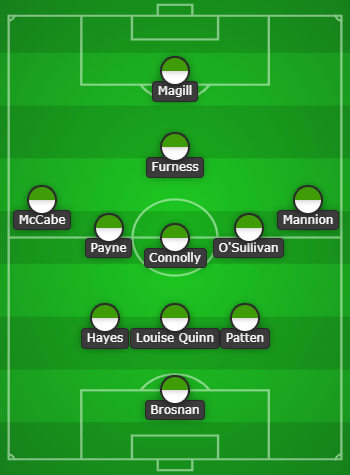
Credit – chosen11.com
Even though they clearly don’t need my input, for fun, here is my combined ROI and NI women’s national team starting XI from current players. Again, it is ROI dominant, but they simply have higher quality players in several positions. It shouldn’t be too surprising anyway since ROI demolished NI 6-1 in a match they played against each other in December 2023. The entire team is made up of ROI players except for the two forward players at the top of the pitch. Goals are an area that ROI struggle with, and NI seem to have a couple of very decent attacking players that could round off this team nicely. Katie McCabe takes on the brunt of goalscoring responsibility for ROI in reality, which would be a fairly difficult task since she also has defensive responsibilities and is expected to track back. Rachel Furness and Simone Magill, both of whom I mentioned earlier, would take some of this pressure off McCabe as they are NI’s first and second top scoring women’s players ever, respectively. Furness actually holds the record for the top scoring Northern Irish international player ever, men’s or women’s. Women’s international soccer still only has a 23-player squad with 12 substitutes on the bench. This bench, for me, would be made up of NI’s Jackie Burns, Lauren Perry, Laura Rafferty, Rebecca McKenna, Nadene Caldwell and Marissa Callaghan. From ROI we’d have Niamh Fahey, Ruesha Littlejohn, Lucy Quinn, Tyler Toland, Amber Barrett and Kyra Carusa.
Outcome
Overall, I think my imaginary merger has gone pretty well. Both organisations are well incorporated into the system and there is room for changes to be made in the future if need be. I think that, at the very least, the merging of the national teams, on both the men’s and women’s sides, would make them more competitive overall. There’d need to be trustworthy people put in high up positions, given the FAI’s history of having con men at the helm. Plus, Irish people love to bandwagon and often the two sets of fans will support the other Irish nation if one is knocked out of a tournament, especially if England are involved. If that’s the case already, why not just have a unified team for everyone to get behind from the start? Especially if, through merging, the one joint side has a chance to be more competitive, or at least not torturous to watch almost every time they play. If done right, the media campaign and hype for a merger like this could be massive too. Generating interest in local clubs, at least for the next generation, could only be a good thing. Traditionally, Irish people support Scotland’s Celtic FC or big English soccer clubs who are either successful or have Irish roots or connections. If given higher quality games at home with better coverage, Irish people wouldn’t need to follow English teams anymore. I myself support Southampton FC in England but also support Shamrock Rovers from Tallaght and have been to more Rovers games than Southampton ones. If we had the level of competition and the potential fierce rivalries that would come with a merger, we wouldn’t look for quality elsewhere and wouldn’t need a plane or boat to go and support our soccer teams.
By Owen Coyne
P.S. I’m not going to do the break down and set up for every single section of the FAI and IFA because: 1. We’d be here forever. 2. The way I’ve done the senior men’s sector can just be replicated down the levels, with changes made as necessary for things like scaling and such.
 Taken to the Corner